Friday, July 10, 2015

TorasChayim: My "Demands"

TorasChayim: My "Demands":


My "Demands"

The headline of the ad on the back page of Hamodia Magazine read: Gedolim and Rabbonim Demand: Turn off your cell phones before davening.
Demand!
The first vision that entered my mind was of visiting my grandparents when I was a child and accompanying my grandfather to shul. If someone spoke during Krias HaTorah  the Rov would walk up to the bimah bang his hand loudly and shout at those who were speaking to quiet down. I can picture him standing there, his facing burning with righteous indignation, his large round eyes giving a piercingly angry look at the transgressors. I was certainly terrified to speak there.
But as my thoughts turned to the present and the issue at hand I realized that what troubled me was:Why is the ad focusing on a symptom instead of worrying about the core issue?
I would encourage you to read the introductory section to Rav Kook's Olas R'Iyah on Tefillah. See how he poetically describes over and over again that Tefillah, being an Avodah She'Ba'Lev, is meant to be an expression of one's pining desire for a relationship with Hashem. As we awake in the morning we are wanting to connect to Him before we go out into the world and engage in our mundane pursuits. As we conclude our workday and are returning home, we desperately desire to reconnect with Hashem to share with Him all the emotions and struggles that we contended with during the day. As we are about to go to sleep we once again want to take leave of Him before we lay down to sleep. If people would come to shuldesperately wanting to utilize the time to enhance their relationship with Hashem would they be taking out their cell phones in the middle of davening?!

Imagine a husband and wife who love each other who have had to be apart for a period of time. Finally, they are able to arrange to spend a weekend in a hotel together. Will anyone need todemand of them to hang the do-not-disturb sign on their door?
But when davening is a Halachic obligation that one must fulfill, or one is davening out of a sense of needing to do it in order to get what he or she wants, and one is lacking that thirst to connect to Hashem, is there any wonder that the result is people speaking on their cell phones? There needs to be a paradigm shift in the wayTefillah is being taught to children as well as to adults. Here are my "demands" to that end:

  • I "demand" that children not be taught to daven until they are old enough to understand what they are saying. (By the way, this is what Chazal teach as well.)
  • I "demand" that the emphasis on Tefillah education be moved from a Halachic based model to one that emphasizes and models the meaning of Avodah She'Ba'Lev. Even teaching the meaning of the words ofdavening, vital as that is, needs to be subordinated to the very foundation of Tefillah itself.
  • I "demand" that the concept of Tov me'at b'kavanah, that it is better to cover less ground in the siddur and to do so with a real connection to Hashem, rather than getting through the prescribed daily Tefillah but lacking any relationship with Hashem, be emphasized in all schools and shuls.
As one of the first steps for the Exodus from Egypt, the Torah says that the King of Mitzryaim died and the Children of Israel sighed from the work and they cried out to Hashem. Mitzrayim  is frequently understood to be a metaphor for being in a constricted place. It is only when we remove the constrictions that bind us, when we let out a sigh of relief from the freedom of seeing Tefillah as work, as a chore that must be done, rather than as something we are chalishing  to do, that we will truly be able to cry out to Hashem and be free.

Monday, July 06, 2015

The United States of America and Divine Providence: American Exceptionalism 101

Expanded versions of quotes from an Editorial in today's HaModia: 

George Washington's 1789 Inaugural Address:

 ...Such being the impressions under which I have, in obedience to the public summons, repaired to the present station; it would be peculiarly improper to omit in this first official Act, my fervent supplications to that Almighty Being who rules over the Universe, who presides in the Councils of Nations, and whose providential aids can supply every human defect, that his benediction may consecrate to the liberties and happiness of the People of the United States, a Government instituted by themselves for these essential purposes: and may enable every instrument employed in its administration to execute with success, the functions allotted to his charge. In tendering this homage to the Great Author of every public and private good I assure myself that it expresses your sentiments not less than my own; nor those of my fellow-citizens at large, less than either. No People can be bound to acknowledge and adore the invisible hand, which conducts the Affairs of men more than the People of the United States. Every step, by which they have advanced to the character of an independent nation, seems to have been distinguished by some token of providential agency. And in the important revolution just accomplished in the system of their United Government, the tranquil deliberations and voluntary consent of so many distinct communities, from which the event has resulted, cannot be compared with the means by which most Governments have been established, without some return of pious gratitude along with an humble anticipation of the future blessings which the past seem to presage. These reflections, arising out of the present crisis, have forced themselves too strongly on my mind to be suppressed. You will join with me I trust in thinking, that there are none under the influence of which, the proceedings of a new and free Government can more auspiciously commence... 

 ...I dwell on this prospect with every satisfaction which an ardent love for my Country can inspire: since there is no truth more thoroughly established, than that there exists in the oeconomy and course of nature, an indissoluble union between virtue and happiness, between duty and advantage, between the genuine maxims of an honest and magnanimous policy, and the solid rewards of public prosperity and felicity: Since we ought to be no less persuaded that the propitious smiles of Heaven, can never be expected on a nation that disregards the eternal rules of order and right, which Heaven itself has ordained: And since the preservation of the sacred fire of liberty, and the destiny of the Republican model of Government, are justly considered as deeply, perhaps as finally staked, on the experiment entrusted to the hands of the American people...

http://www.archives.gov/exhibits/american_originals/inaugtxt.html 


Thomas Jefferson, in Notes on the State of Virginia, inscribed on the Jefferson Memorial:

...And can the liberties of a nation be thought secure when we have removed their only firm basis, a conviction in the minds of the people that these liberties are the gift of God? That they are not to be violated but with his wrath? Indeed I tremble for my country when I reflect that God is just: that his justice cannot sleep for ever... - Notes on the State of Virginia, Query XVIII 

http://www.monticello.org/site/jefferson/quotations-jefferson-memorial 


And, whether you agree with him or not, here is a contemporary perspective: 

Scalia defends keeping God, religion in public square 
By Valerie Richardson - The Washington Times - Wednesday, October 1, 2014 

LAKEWOOD, Colo. — 

Supreme Court Justice Antonin Scalia said Wednesday that secularists are wrong when they argue the Constitution requires religious references to be banished from the public square. 

Justice Scalia, part of the court's conservative wing, was preaching to the choir when he told the audience at Colorado Christian University that a battle is underway over whether to allow religion in public life, from referencing God in the Pledge of Allegiance to holding prayers before city hall meetings. 

"I think the main fight is to dissuade Americans from what the secularists are trying to persuade them to be true: that the separation of church and state means that the government cannot favor religion over nonreligion," Justice Scalia said. 

"That's a possible way to run a political system. The Europeans run it that way," Justice Scalia said. "And if the American people want to do it, I suppose they can enact that by statute. But to say that's what the Constitution requires is utterly absurd."

Justice Scalia's remarks came as part of a day of public appearances in Colorado. He lectured students on the Commerce Clause during a morning class, and then received an honorary doctorate prior to his luncheon speech from CCU President Bill Armstrong. 

"At no place on Earth does Justice Scalia have as many admirers as he does on the Colorado Christian University campus," said Mr. Armstrong, a former U.S. senator. 

Justice Scalia was slated to give the keynote address Wednesday night at a conference at the University of Colorado Law School in Boulder. The high court's longest-serving justice, Justice Scalia said that even President Thomas Jefferson, who's credited with creating the concept of separation of church and state, wrote in the Virginia Declaration of Religious Freedom that, "God who made the mind of man made it free." 

"We do him [God] honor in our pledge of allegiance, in all our public ceremonies," Justice Scalia said. "There's nothing wrong with that. It is in the best of American traditions, and don't let anybody tell you otherwise. I think we have to fight that tendency of the secularists to impose it on all of us through the Constitution." 

The biggest danger lies with judges who interpret the Constitution as a malleable document that changes with the times, he said. 

"Our [the court's] latest take on the subject, which is quite different from previous takes, is that the state must be neutral, not only between religions, but between religion and nonreligion," Justice Scalia said. "That's just a lie. Where do you get the notion that this is all unconstitutional? You can only believe that if you believe in a morphing Constitution." 

Given that he doesn't believe in the "morphing Constitution," Justice Scalia said his job is relatively stress-free. 

"If I had the other view of the Constitution — that it was an empty bottle, which was to be filed by my court, and it was my responsibility to decide . . . all these massive ethical questions — if they were all my call, I couldn't sleep at night," Mr. Scalia said. "And some of my colleagues have said, 'Oh, we agonize a lot.' I don't agonize at all. I look at the text, I look at the history of the text. That's the answer. It's not my call." 

He noted that references to God by government officials are already forbidden in many European countries, thanks to a widespread policy of secularism. 

"There are those who would have us adopt that rule for America, and if they want us to adopt that rule, let's put it to a vote," Justice Scalia said. "But they want to do it through the Supreme Court. And that is simply not what our Constitution has ever meant." 

Appointed to the court by President Reagan in 1986, Justice Scalia joked during a question-and-answer session that he doesn't let the pressure of the bench get to him. 

"What can they do to me? I have life tenure," Justice Scalia said. "It's even better than academic tenure." 

© Copyright 2015 The Washington Times, LLC. 

http://www.washingtontimes.com/news/2014/oct/1/justice-antonin-scalia-defends-keeping-god-religio/print/

Thursday, July 02, 2015

Parashas Balak: Deir 'Alla Inscription - Livius

Deir 'Alla Inscription - Livius


Why is this not more widely known?


Deir 'Alla Inscription

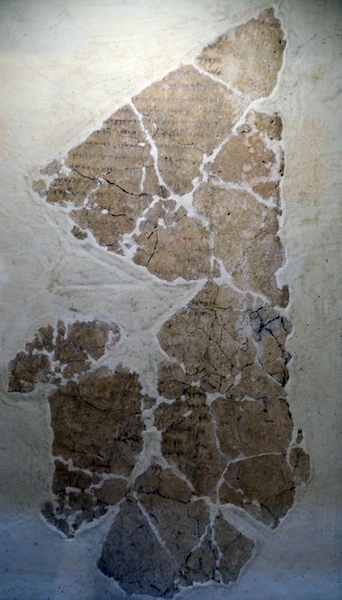
Deir 'Alla Inscription: inscription, found in the Iron Age town of Deir 'Alla, mentioning the Biblical prophet Balaam.
Deir 'Alla Inscription
Deir 'Alla is situated in western Jordan, about eight kilometers east of the river Jordan, and about a kilometer north of the Jabbok. The excavators found a very large Bronze Age sanctuary that had suffered in the period of wide-spread destruction in the thirteenth/twelfth centuries. Unlike other settlements, which were abandoned, Deir 'Alla remained in use well into the fifth century BCE. That is remarkable.

Even more remarkable, however, was the discovery of a painted text that contained a prophecy by Balaam, a non-Israelite prophet who is mentioned in the Biblical book of Numbers 22-24 as a servant working for the Moabite king Balak. (The site of Deir 'Alla is, technically, on the Ammonite side of the river Jabbok.) The text refers to divine visions and signs of future destruction, in a language that is close to that of the Bible. For example, we read about the "Shaddai gods", an expression that is close to the BiblicalEl Shaddai, "God Almighty". On the other hand, the setting is not monotheistic: we read, for instance, about a gathering of a group of gods. The word elohim, which in the Bible (although plural) refers to one God, refers to more than one god in the Deir 'Alla text.
Reconstructing the contents is difficult, but it is clear that Bileam learns from the gods that the world will be destroyed, an apocalyptic event that is described with metaphors from bird life. Somehow, Bileam and his people seem to have averted this disaster. There is also a description of the Underworld.
The text, in a language between Aramaic and Canaanite, can be dated to c.800 BCE. It was discovered in 1967 by Dutch archaeologists, and the first edition, by Hoftijzer and Van der Kooij, is from 1976. The scholars were able to form two large and ten small combinations of matching fragments. Since then, scholars have been able to improve their readings. The translation offered here is by B.A. Levine, who also inserted the titles. It was published in 2003 and consists of the two main combinations, minus the two first lines of Combination 2.
These two lines, and the small combinations, are offered in the original translation by Hoftijzer and Van der Kooij (1976); to discern them from Levine's translation, these lines have been printed in italics. Their book also contains photos, drawings, and the most detailed description of the fragments.

Literature

  • J. Hoftijzer and G. van der Kooij, Aramaic Texts from Deir 'Alla (1976)
  • B.A. Levine, "The Deir 'Alla Plaster Inscriptions", in: W.W. Hallo (ed.), Context of Scripture, vol.2 (2003), 140-145.

Combination I

Title

[i.1] The misfortunes of the Book of Balaam, son of Beor. A divine seer was he.

The Theophany

[i.2] The gods came to him at night.
And he beheld a vision in accordance with El's utterance.
They said to Balaam, son of Beor:
"So will it be done, with naught surviving.
No one has seen [the likes of] what you have heard!"

Balaam Reports his Vision to His Intimates

[i.5] Balaam arose on the morrow;
He summoned the heads of the assembly to him,
[i.6] And for two days he fasted, and wept bitterly.
Then his intimates entered into his presence,
and they said to Balaam, son of Beor,
"Why do you fast, and why do you weep?"
[i.7] Then he said to them: "Be seated, and I will relate to you what the Shaddai gods have planned,
And go, see the acts of the god!"

Balaam Describes the Celestial Vision and Its Aftermath in the Land

"The gods have banded together;
[i.8] The Shaddai gods have established a council,
And they have said to [the goddess] Shagar:
'Sew up, close up the heavens with dense cloud,
That darkness exist there, not brilliance;
Obscurity and not clarity;
[i.9] So that you instill dread in dense darkness.
And - never utter a sound again!'
[i.10] It shall be that the swift and crane will shriek insult to the eagle,
And a nest of vultures shall cry out in response.
The stork, the young of the falcon and the owl,
[i.11] The chicks of the heron, sparrow and cluster of eagles;
Pigeons and birds, [and fowl in the s]ky.
And a rod [shall flay the cat]tle;
Where there are ewes, a staff shall be brought.
Hares - eat together!
Free[ly feed], oh beasts [of the field]!
And [freely] drink, asses and hyenas!"

Balaam Acts to Save the Goddess and the Land

[i.12] Heed the admonition, adversaries of Sha[gar-and-Ištar]!
... skilled diviner.
To skilled diviners shall one take you, and to an oracle;
[i.14] To a perfumer of myrrh and a priestess.
Who covers his body with oil,
And rubs himself with olive oil.
To one bearing an offering in a horn;
One augurer after another, and yet another.
As one augurer broke away from his colleagues,
The strikers departed ...

The Admonitions are Heeded; The Malevolent Gods are Punished, the Goddess Rescued, and the Land Saved

[i.15] They heard incantations from afar 
...
Then disease was unleashed
[i.16] And all beheld acts of distress.
Shagar-and-Ištar did not ...
[i.17] The piglet [drove out] the leopard
And the ... drove out the young of the ...
.. double offerings
And he beheld ...

Combination II

[ii.4] .. a girl those who were used? to be saturated with love ...
[ii.5] .. a blinded one and the whole moistened? soil? ...

(A) El Builds a Necropolis

[ii.6] El satisfied himself with [lovemaking]
And then El fashioned an eternal house;
[A house ...]
[ii.7] A house where no traveler enters
Nor does a bridegroom enter there

(B) A Half-existence in Sheol

[ii.8] Worm rot from a grave.
From the reckless affairs of men.
And from the lustful desires of people.

(C) The Rejection of a Seer

[ii.9] If it is for counsel, on will not counsel with you!
Or for advising him, one will not take advice!

(D-E) More on Conditions in Sheol

[ii.10] From the bed they cover themselves with a wrap.
If you hate him, he will be mortally afflicted.
If you ...
...
[Worm rot] is under your head.
You shall lie on your eternal bedding,
To pass away to ...

(F-G) Kings and Other Corpses in Sheol

[ii.12] ... in their heart.
The corpse moans in his heart,
He moans ...
---
... a daughter.
There, kings behold ...
[ii.13] There is no mercy when Death seizes a suckling.
And a suckling ...
And a suckling ...
A suckling ...
There ... shall be.
[ii.14] The heart of the corpse is desolate
As he approaches [Sheol]. ...
To the edge of She[ol],
And the shadow of the hedge ...

(H-I) An Oracle: The Quests of Kings and Seers Come to Naught

[ii.15] "The quest of a king is moth rot,
And the quest of ... ... seers.
[ii.16] Your quest is distant from you.
To know how to deliver an oracle to his people.
You have been condemned for your speech
[ii.17] And [banned] from pronouncing words of execration.
[Lines ii.18-29 are incomprehensible.]
[ii.30-37] El will be wrathful ... ...
he will eat ... ...
my heart is a heart? ...
[Incomprehensible]
... for three?...
She? will drip of abundant? rain ...
She? will drip of dew and ...
... look for fodder and he? will eat ...

Other Combinations

[iii] iv.a.3 ... for heat? ...
iv.g.i ... green herbs ...
v.c.3 ... she? will faint ...
v.c.4 ... he was pulled down? ...
v.d.2 ... sprinkle ...
v.d.3 ... they came in crowds ...
v.f.2 ... hasten ...
v.q.1 ... horse and ...
vii.c.3 ... bone/strong/strength...
viii.b.1 ... head ...
viii.b.2 ... desire ...
viii.d.2 ... and Balaam, the son of Beor ...
ix.a.3 ... he is not cursed, his hands ...
x.b.1 ... is my lady?, Shagar? ...
x.d.2 ... for? him/her, his/her hands will wither. Take? ...
x.d.3 ... brother and chieftain? ...
xi.b.1 ... in the depths ...
xii.c.2 ... Balaam, the son of Beor, saying you/she will...
This page was created in 2009; last modified on 1 February 2015.

Monday, June 29, 2015

Shabbos Bicycles?

Rabbi Dr. Nathan Lopes Cardozo advocates permitting the riding of bicycles on Shabbos. He argues that this will increase Shemiras Shabbos. See:

http://blogs.timesofisrael.com/take-the-bike-or-tram-get-a-free-coffee-and-observe-shabbat/

In this regard, I would like to share an old Mail-Jewish post that I wrote:

http://www.ottmall.com/mj_ht_arch/v9/mj_v9i79.html#CRO


From: (Yosef Bechhofer) 
Date: Tue, 2 Nov 93 19:45:46 -0500 
Subject: Bicycles on Shabbos and Related Issues 

I don't wish to comment on the precise Halachic details of bicycles on Shabbos, rather I would like to use this issue to make a related point. There is a "reductionist" tendency in some Halachic circles, albeit not necssarily this one, but others, which is, basically: "If you cannot prove to me what precise definition of pre-established melacha/issur, etc. this fits into, it must automatically be permissible. In this regard it is important to note what the Chazon Ish zt'l says about umbrellas on Shabbos. 

In Orach Chaim 52:6 the Chazon Ish takes issue with the conventional wisdom, the Noda b'Yehuda, who bans umbrellas on Shabbos as temporary tents (ohel). Rather, he says, the opening of an umbrella is similar to "fixing" (tikkun mana), but even that is not a true comparison. He goes on to state that the reason one is forbidden to use an umbrella on Shabbos (even where there is an eruv) is because: 

"It is a very public workaday act (avsha milsa / uvda d'chol) and causes a breach in the sanctity of Shabbos... The determination of which public acts descrate the Shabbos to too great an extent is something that is given over to the sages [of each generation, obviously - there were no umbrellas, much less a prohibition at the time of Chazal] to erect fences in places of possible breaches, and such public matters of Shabbos sanctity are more severe than any private specific prohibitons, because this is a fence for the entire nation for all times."

(My free translation.)

I always understood the severity of a Jew's opening his store on Shabbos, despite the relative light nature of the ban on business transactions on Shabbos, as related to the Chazon Ish's fundamental concept.

Sunday, June 28, 2015

אמונה למעלה מהשכל

I recevied the following critique, from which my position should be understood:

I would rephrase the dichotomy by saying that where misnaged, having unwavering commitment to and absolute belief in supremacy of his own seichel, would jump to conclusions based on apparent contradiction, a chosid would exercise his emunah in a Tzadik and let his seichel conform to it - either by admitting his limitations in understanding the reality, rethinking past views or finding new insights. In any event, this is not an expression of fundamental intellectual dishonesty - not being able to admit the wrongs of his Rebbe - as YGB intimated.

I am not aware of any Jewish school of thought though, that would not place the koach of emuna as a higher faculty in relation to one's intellect. Emuna, as being rooted in the more sublime aspect of one's soul does supersede one's intellectual capacity. If you are aware of the alternative worldview, please share it with us. As for your claim of opposition to Chabad for its insistence on Emunah being hierarchically higher than seichel and the claim that this aspect of Chabad ideology being identified as “karov leavoda zara”: you are well aware of the gravity of such charge. I would assume that the oilom would appreciate if you would provide the names and makoiros of writings that espouse such view(s). I would encourage you to kindly share those sources. Alternatively, I would suggest to classify your statement as emotionally driven, common anti-Chabad slur and treat it accordingly. 

Now, this is not really "Chabad ideology." It is a distortion of the actual Chabad notion of:

 איתא במדרש "פתי יאמין לכל דבר - זה משה". והרי פשיטא שאף אחד לא ישאל מהו החילוק בין "פתי יאמין" כפשוטו לדרגא ד"פתי יאמין" שנאמרה אודות משה רבינו - אמונה שלמטה מהשכל ואמונה שלמעלה מהשכל!... אם מישהו זקוק להסבר וביאור בדבר - אינני יודע אם שייך בכלל לעזור לו בזה!... (התוועדויות תשד"מ ח"ד עמ' 2567)

Which refers to emunah on the level of Moshe Rabbeinu - an emunah that comes after revelation. It is used in contemporary Chabad Meshichist circles, for the most part, to justify belief in the Rebbe as Moshiach even after Gimmel Tammuz. Such, as in the use of a Meshichist website:

 עמידה בתוקף האמונה מול מציאות שלכאורה סותרת את האמונה (=נסיון). "וגם כשנדמה שיש איזה בלבול הרי הולכים בדרכו של אברהם אבינו, היהודי הראשון, שבראותו נהר המעכבו מלקיים ציווי השם, עמד בתוקף ולא נתפעל"

The usage there in itself is absurd, as Avraham Avinu was the first one to come to cognition of Hashem through logic and reason. Any subsequent Emunah above logic and reason was on account of the revelation that followed the logic and reason.

So why is the concept "close to Avodah Zarah?" Because the way it is used in the circles in which it is used is as an argument to check one's logic and reason at the coat check. Well, if logic and reason are discarded, then whatever whim of faith or religious experience - or, even more so, the faith in which one was raised - are necessarily the primary basis of one's religious choices in this world. Emotion over intellect.

If that is the case, a proponent of another religion is justified in arguing that you cannot know his religion to be wrong until you have its religious experience. A person born into idolatry cannot be held responsible (as Halacha does, as Reb Elchanan explains in his famous essay), as that is his religious experience - more so, the faith in which he was raised. There would be no anchor for perspective other than feeling. And one who once might feel an ecstatic experience in another religious setting would be compelled by the pinciple to go with it. And that would be the lower form of pesi ya'amin l'kol davar. V'ha'meivin yavin.