
Der Alter has sent you a link to a weblog:
Blog: Der Alter
Post: Is Social Justice Only for Reform Jews?
Link: http://deralter.blogspot.com/2006/05/is-social-justice-only-for-reform-jews.html
--
Powered by Blogger
http://www.blogger.com/

Rabbi Yosef Gavriel Bechhofer הרב יוסף גבריאל בקהופר
Thursday, May 11, 2006


Wednesday, May 10, 2006
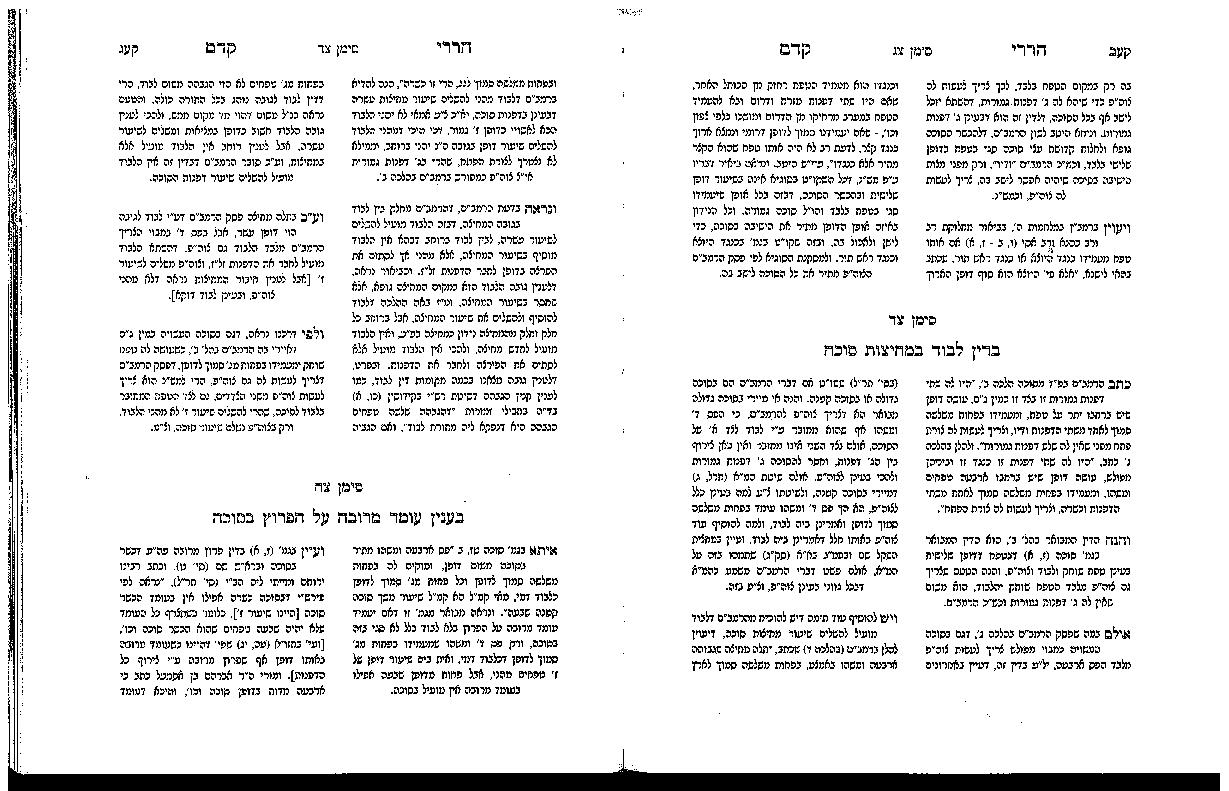

Lavud Continued
A correspondent wrote, in response to a response:
-----Original Message-----From: Yosef Gavriel Bechhofer rygb@aishdas.org
**** wrote:
>> In the Hararei Kedem to Sukkah 7a it is stated that RYBS suggested
>> that lavud only is effective (in creating a wall) horizontally, not
>> vertically. It is very convenient to say so in the sugyah there, but
>> very mechudash. Anyone ever heard such a thing before?
> It must be a total lack of understanding on my part, but isn't the
> opposite a mishna m'fureshes in Eiruvin 16b, "Makifin bishlosha chavalim
> zeh l'ma'lah mizeh"?
But in that same Mishna it adds Kanim and as Rashi says that Chavolim are Erev (horzontal) Kanim are Shesi (vertical).However perhaps RYBS was making this distinction only WRT Sukkah, as we find such distinction in the Maharsha, brought by the Mogein Avraham begining of 630, (as explained by the Lvushei Srad and Machatzis Hasehekel there), although there it is the exact opposite that Erev (horizontal) is worse then Shesi (vertical).
To which I respond:
RYBS is nosei v'nosein in that MA and MhS etc. His basic issue is that the Rambam in Hil. Sukkah 3:3 rules, according to the MA in the Rambam, that in a sukkah ketanah you need a tzuras ha'pesach besides the pas arba, which is shverr because anyway lavud should be mashlim the dofen. Yet in 3:4 the Rambam rules that a horizontal lavud *is* mashlim a mechitza.On this RYBS says a lavud works for the height of the wall to be mashlim 10t, but not in the width of the wall to be mashlim 7t, but only to close the pirtza. He goes on to "explain" that the height of a wall is one indivisible unit - because it is all one place - while the width of a wall is many separate parts (sounds very Rogatchoverish, but very unclear!). He notes that we find elsewhere horizontal lavud, such as in terms of kinyan hagbaha (more and more R'ish!!) in Kid. 26a. Hence, while lavus close the gap between the walls, it is the tzuras ha'pesach that is mashlim the shiur. (He then goes on to derive ramifications for the din of asui k'min gam).
Did RYBS forget the sugya several blatt hence of petzimei achsadra?!
In any event, I would like to understand this RYBS, because if it works out it is very helpful to a hypothesis I just developed to distinguish between a "dofen" (a unique law in Sukkah) and a "mechitza." V'dok.
KT,YGB
-----Original Message-----From: Yosef Gavriel Bechhofer rygb@aishdas.org
**** wrote:
>> In the Hararei Kedem to Sukkah 7a it is stated that RYBS suggested
>> that lavud only is effective (in creating a wall) horizontally, not
>> vertically. It is very convenient to say so in the sugyah there, but
>> very mechudash. Anyone ever heard such a thing before?
> It must be a total lack of understanding on my part, but isn't the
> opposite a mishna m'fureshes in Eiruvin 16b, "Makifin bishlosha chavalim
> zeh l'ma'lah mizeh"?
But in that same Mishna it adds Kanim and as Rashi says that Chavolim are Erev (horzontal) Kanim are Shesi (vertical).However perhaps RYBS was making this distinction only WRT Sukkah, as we find such distinction in the Maharsha, brought by the Mogein Avraham begining of 630, (as explained by the Lvushei Srad and Machatzis Hasehekel there), although there it is the exact opposite that Erev (horizontal) is worse then Shesi (vertical).
To which I respond:
RYBS is nosei v'nosein in that MA and MhS etc. His basic issue is that the Rambam in Hil. Sukkah 3:3 rules, according to the MA in the Rambam, that in a sukkah ketanah you need a tzuras ha'pesach besides the pas arba, which is shverr because anyway lavud should be mashlim the dofen. Yet in 3:4 the Rambam rules that a horizontal lavud *is* mashlim a mechitza.On this RYBS says a lavud works for the height of the wall to be mashlim 10t, but not in the width of the wall to be mashlim 7t, but only to close the pirtza. He goes on to "explain" that the height of a wall is one indivisible unit - because it is all one place - while the width of a wall is many separate parts (sounds very Rogatchoverish, but very unclear!). He notes that we find elsewhere horizontal lavud, such as in terms of kinyan hagbaha (more and more R'ish!!) in Kid. 26a. Hence, while lavus close the gap between the walls, it is the tzuras ha'pesach that is mashlim the shiur. (He then goes on to derive ramifications for the din of asui k'min gam).
Did RYBS forget the sugya several blatt hence of petzimei achsadra?!
In any event, I would like to understand this RYBS, because if it works out it is very helpful to a hypothesis I just developed to distinguish between a "dofen" (a unique law in Sukkah) and a "mechitza." V'dok.
KT,YGB
Monday, May 08, 2006
Lavud
In the Hararei Kedem to Sukkah 7a it is stated that RYBS suggested that lavud only is effective (in creating a wall) horizontally, not vertically. It is very convenient to say so in the sugyah there, but very mechudash. Anyone ever heard such a thing before?
Monday, May 01, 2006



Subscribe to:
Posts (Atom)