
Rabbi Yosef Gavriel Bechhofer הרב יוסף גבריאל בקהופר

Tuesday, March 12, 2019
About Goyim: Notes on Rabbi Micha Berger's Religious Dilemma
There is significant follow up on the issues at Reb Micha's original post,
https://www.facebook.com/notes/micha-berger/religious-dilemma/10154373582687263
Important points I added are:
1. I forgot to mention that a goy can only bring a Korban Olah, not a Shelamim. This is very much linked, and really is a fundamental source, for the dichotomy I presented.
2. I was myself somewhat guilty of imprecision in terminology. "Taharah" as I meant it is not Halachic Taharah, of course. Rather, it is the Nekiyus, Perishus and, ultimately the Taharah of the Mesillas Yesharim. That is the highest level open to a goy. From the Chassidus of the Mesillas Yesharim and beyond is only available to Jews.


Wednesday, March 06, 2019
Saturday, March 02, 2019
Toras Purim 5779 part 1, Shomrei HaSaf

We were mevarech Chodesh Adar Sheni, it's time.
This is an introduction. I am NOT yet sure where I'm going from here...
- Integral to Purim is the plot of Bigsan and Seresh.
- They were the שומרי הסף.
- So there were two שומר הסףs.
- Two times שומר הסף is in gematriya 1382 (691x2).
- This is the same gematriya as:
משנכנס אדר מרבין בשמחה
and as
- ענבי הגפן בענבי הגפן דבר נאה ומתקבל
Hmm...
Now, in Melachim II 25:18 there are three Shomrei HaSaf, from which the Gemara in Sanhedrin 10b derives that the consideration of whether to add an Adar II to make a leap year begins with three people, before going up to five an then to seven.
So who was the third Shomer HaSaf?
Esther Rabbah (6:13) give the answer: Mordechai!
בימים ההם ומרדכי יושב בשער המלך קצף בגתן ותרש שני סריסי המלך וגו' מה קצפון היה שם מעביר שנים ומשיב אחד מעביר שני קלסריקין שהן שומרי הסף ומושיב הברברי הזה יושב בשער המלך ר' ברכיה בשם ר' לוי אמר כתיב (תהלים מ"ו) לכו חזו מפעלות ה' אשר שם שמות בארץ הקציף עבדים על יד אדוניהם לתת גדולה לצדיקים הה"ד קצף בגתן ותרש וגו' לתת גדולה למרדכי מקציף אדונים על עבדיהם לתת גדולה ליוסף הה"ד (בראשית מ"א) פרעה קצף על עבדיו
(See the Tiferes Zion at http://hebrewbooks.org/pdfpager.aspx?sits=1&req=6738&st=קצפון&_rnd=0.8479636722930861.)
Clothing
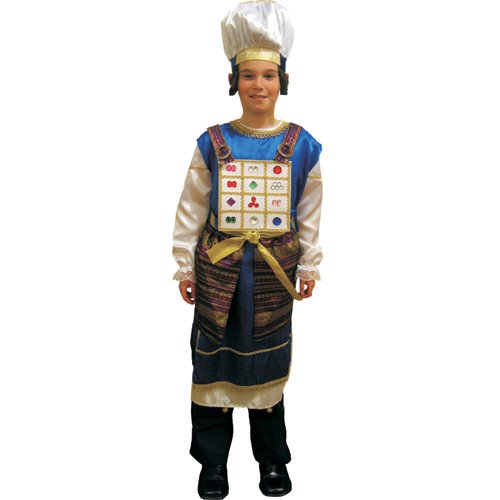
Part of a talk I gave to the Shalhevet Girls High School in Vancouver,
where our daughter Rebbitzen Federgrun is the Menaheles.
Summarized by Rebbitzen Federgrun.
A
person's clothing send a subtle signal of what they represent and whom
they respect in this world. When we dress a certain way, we tend to act a
certain way. In Judaism, we generally don't have uniforms as part of
our religious routines. We may have a special article of clothing to
wear at specific times, but the only place/time where we find a
"uniform" was in the Beis Hamikdash. Rabbi Soloveitchik once
said, "Judaism doesn't believe in rituals for the sake of ritual.
Everything we do has a deeper meaning and reasoning behind it." Yet,
again, in the Beis Hamikdash, there were rituals - and they meant a lot! Why was the Beis Hamikdash different in these regards?
There's an idea in Kabbalah of hod - splendor. There is hod of Hakadosh Baruch Hu in the world He has created. We say in Barchi Nafshi, "Hod v'hadar lavashta - You (Hashem) donned splendor and glory." This middah of hod is one Hashem used in creating the world. Thus, when we look at the amazing world around us, we are, in a sense, seeing that which Hashem wears to show us His majesty.
When we see hod, we feel awe. We recognize the greatness of what we are seeing and experiencing, and we want to associate with it.
The Beis Hamikdash is supposed to be the place where Hashem's hod is appreciated most. Only there were kohanim given a "uniform" to wear: the bigdei kehunah. And there we experienced religious rituals. The reason these could happen in the Beis Hamikdash, is because the Beis Hamikdash itself was the pinnacle of kedusha in the world. Therefore its hod could be accurately recognized as the splendor of Hashem. Instead of focusing on the externals, those in its proximity focused on the spirituality of what was happening around them.
This week we read Parshas Shekalim, which tells us how each Jew brought half a shekel to be used for the services in the Beis Hamikdash. The Sfas Emes explains that the idea of mishenichnas Adar marbin b'simchas begins with the reading of Parshas Shekalim. This money was brought with joy, and that joy carries through the generations until today. Part of the great joy in giving 1/2 shekel lies in its representation that we give half, and Hashem gives half, and we meet Him in the middle. So the joy of Adar is the joy of getting close to Hakadosh Baruch Hu.
Everything
we see, do, hear, etc has an impact upon us - consciously or
unconsciously. We aren't perfect, but we should strive in all we do to
increase our simcha by doing things that bring us closer to Hashem.
Tuesday, February 12, 2019
New evidence that the 165 missing years are fictitious
 |
| VAT 4956 |
An intellectually enterprising sophomore at a well knowמ yeshiva high school in the NY area has been trying to convince me of the error of my ways in asserting that Chazal's chronology is correct and the secular chronology in accurate.
In his eagerness, he introduced me to VAT 4956, a tablet from the 37th year of the reign of Nebuchadnezzar.
Indeed, with utterly flawed reasoning, this site:
http://www.lavia.org/english/archivo/vat4956en.htm
used that tablet to "prove" that the 37th year of Nebuchadnezzar was 568 BCE, and that the Churban was in 586 BCE. He even coaxes the translation of obverse, line 17, to prove his point.
But his translation is probably doctored by him for his own purposes... Although even he couldn't gloss over the actual dates.
Hers is another translation, from http://2043ad.com/timeandprophecy.pdf, page 87:
"The 9th, solstice. Night of the 10th, first part of the night, the moon was balanced 3½ cubits above á Scorpii. The 12th, Mars was b cubits above [á Leonis ...] The 15th, one god was seen with the other; sunrise to moonset: 7E30N. A lunar eclipse which was omitted ... "
The 15th is the 15th day of Sivan, the third month.
There is one year, only, in which there was a lunar eclipse on the 15th day of Sivan.
Now, for the same reason that the Churban of Bayis Sheni is often cited as 70 CE even though it really took place in 68CE (problems with the switch from negative to positive numbering), 409 BCE by our count corresponds to 410 BCE by the Roman count (see http://www.cgsf.org/dbeattie/calendar/?roman=-409
In that year - and only in that year - was 15 Sivan the requisite number of six days after the solstice on the 9th of Sivan ("The date varies between June 20 and June 22, depending on the year, and the local time zone." - https://www.timeanddate.com/calendar/june-solstice.html).
409 BCE
-409 Jun 28 12:50:51 Tot A 0.0152 1.8301 342.3 222.5 102.7 10:59:36 11:59:30 13:42:12 14:42:06 [219]
from https://en.wikipedia.org/wiki/List_of_5th-century_BCE_lunar_eclipses
To be perfectly honest, this leaves us with a discrepancy of about seven years, as it would place the Churban at 427 BCE as opposed to the traditional 420 BCE. But as I told that budding young scholar, I can't live with 165 missing years, but I can live with 7 missing years.
ברוך אשר בחר בחכמים ובמשנתם
Subscribe to:
Posts (Atom)